Electric fields and potential control reactions on catalyst surfaces in distinct ways
Researchers show that applied potential and electric fields affect electrochemical reactions independently, which may inform future catalyst design.
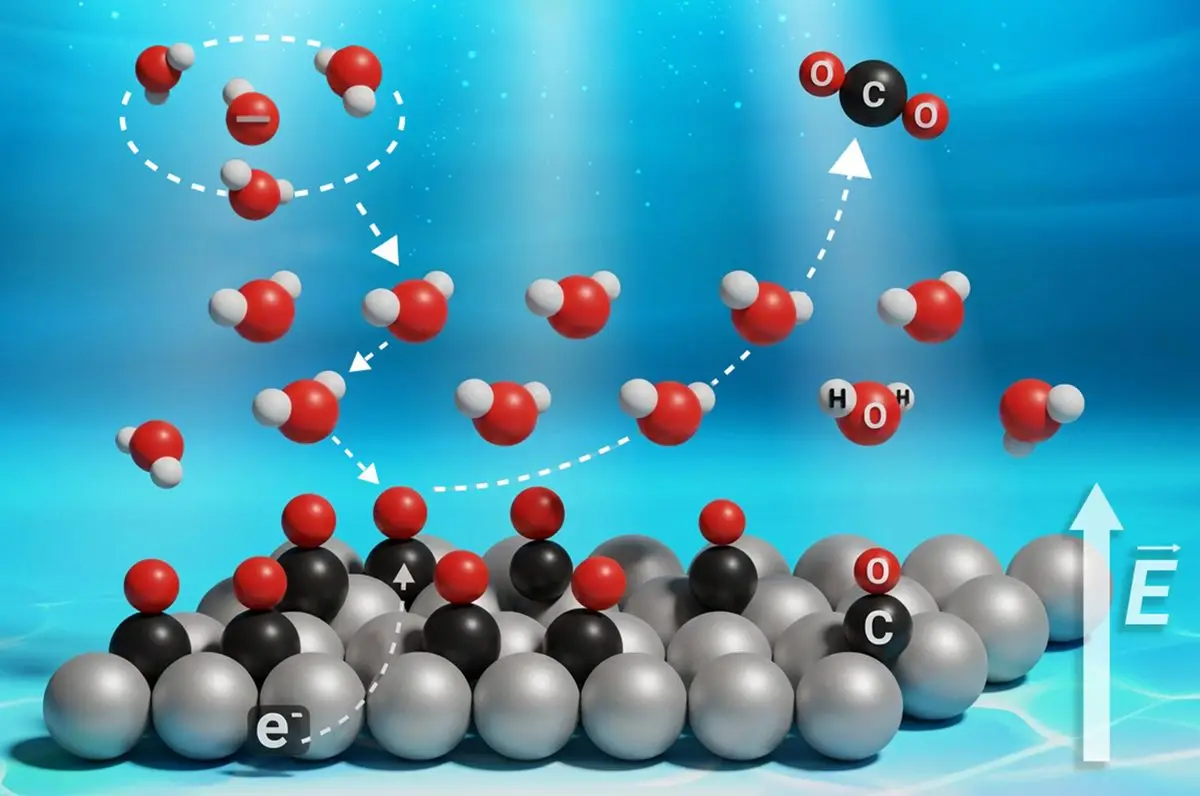
Researchers at the Interface Science Department (ISC) have demonstrated that electrochemical reactions at solid-solution interfaces are influenced by two separate but related factors: the applied potential, which drives reactions forward, and electric fields in the surrounding environment, which modulate activation parameters without providing a thermodynamic driving force.
The team, led by Dr. Sebastian Oener within Prof. Roldán Cuenya's group, achieved independent control over both the applied potential and the electric field magnitude at a fixed potential. Their study, published in Nature Chemistry, focused on carbon monoxide (CO) oxidation on a Pt(111) single-crystal surface. Doctoral student Caroline Aschendorf adsorbed a known amount of CO onto the surface and oxidatively stripped it at an applied step potential, extracting a continuous current versus coverage dependence at constant step potentials.
By repeating these transients at different temperatures and performing electrochemical Arrhenius analysis as a function of both step potential and CO coverage, the researchers extracted apparent activation parameters for a Faradaic reaction with two independent experimental control variables. They found that increasing the applied potential decreased the apparent activation energy, while increasing the difference between the applied potential and the potential of zero total charge—at a fixed potential—increased the apparent activation energy. This suggests that reaction speed depends on how potential redistributes charge and alters chemical potentials, including in the interfacial double layer.
The findings link the potential of zero charge to Faradaic reaction kinetics, a long-standing goal in electrochemistry. The researchers indicate that future catalysts and electrodes could be designed to intentionally adjust electric fields, potentially lowering the cost of green hydrogen and improving renewable energy use.
Source: Phys.org